






By Jeff Odom & Kristen Binz
Assistant Managers for Dive Maintenance – Georgia Aquarium
31 January 2026

Sand & gravel had been piling up in the sump of Ocean Voyager, our 6 million gallon whale shark habitat, for 15 years. It accumulated slowly, as substrate picked up by foraging rays was sprinkled over filtration intakes recessed in the exhibit floor. When we made our first assessment dives in late 2023, the sump’s substrate mountain was almost 10 feet tall, gradually tapering to floor level over a distance of 80 feet. Concerned about the loss of substrate in the exhibit, and unsure when the accumulation would begin to impede the filtration systems, Husbandry and Life Support enlisted our help to clean out the sump.
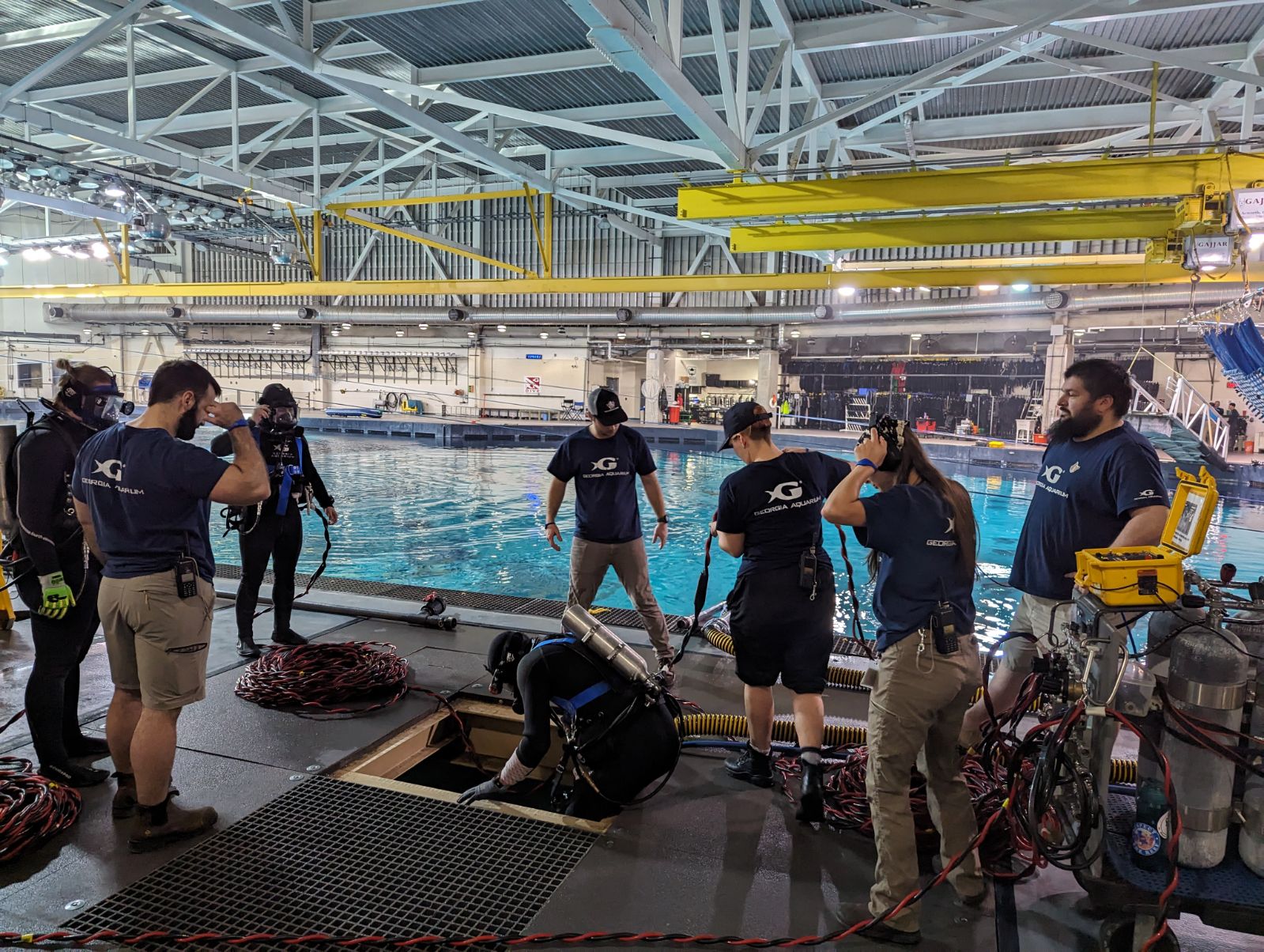 A diver entering the Ocean Voyager sump finds him or herself in a challenging environment. After lifting floor panels on the habitat deck, a surface supply diver climbs down into a narrow cavernous chamber: 40ft deep, almost a football field long (running parallel to the habitat), and crisscrossed with piping. Although there is an air pocket at the top of the sump, it is essentially an overhead environment – a diver will not be able to surface immediately unless they swim out through the maze of pipes exactly the same way that they went in.
To accomplish working dives here, we implemented a number of safety measures in a modified surface-supply operation. Topside, we had a DPIC and tender managing “Big Mama,” a mobile cart of eight HP120’s tied together (with one of the HP120’s isolated in reserve, and an extra K-bottle standing by). The tender had a headset and was in constant voice communication with the divers. Canister lights and bailout bottles with multiple regulators were staged inside the sump, with emergency oxygen & an extrication board available on deck. Two additional staff helped the tender & DPIC to wrangle hoses and prep the divers.
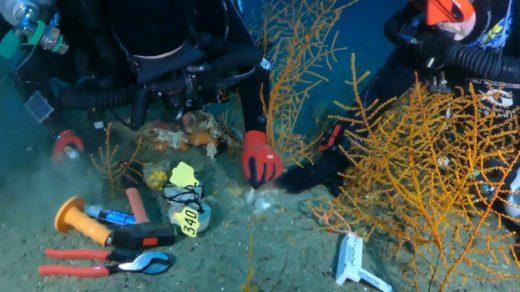
Three divers worked as a team to tackle the substrate mountain. The pile was soft on the outside, but dense concrete in the middle! Two divers used chisels, rock hammers, garden hoes, and pry bars to break apart the compacted substrate. Then they shoveled it over to the third diver, who handled an airlift.
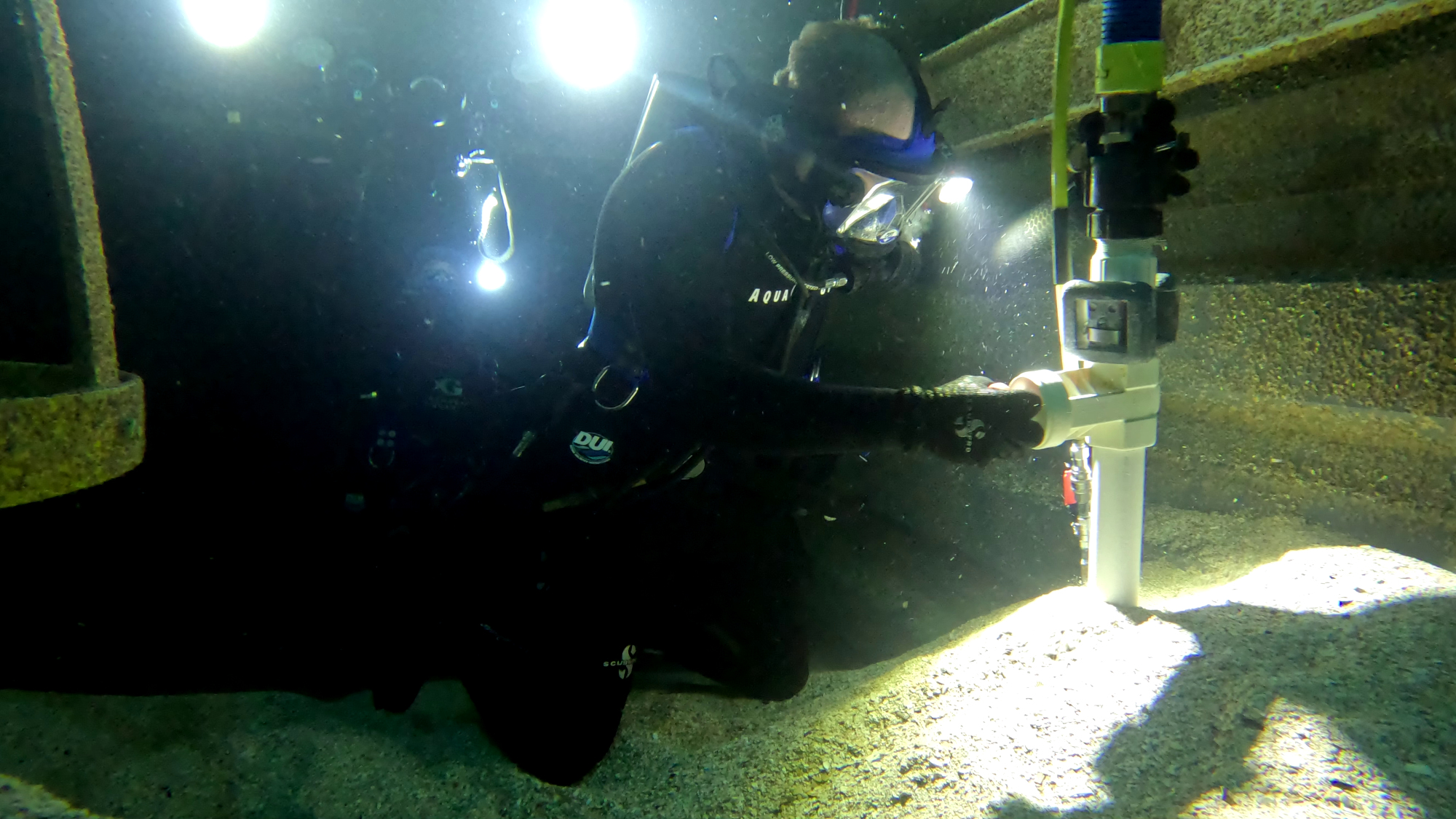 For the airlift, we plumbed a ¾” LP hose into a PVC nozzle and 3” pool hose, then routed the 3” hose out of the sump and straight back into the main habitat. High-volume “house air” from the aquarium’s large industrial compressors supplied the LP hose which powered the airlift. That air, injected into the PVC nozzle, would rise up through the 3” hose, generating suction, and would draw the sand and gravel along with it.
Topside, the fountain of sand returning to Ocean Voyager became an unexpected animal enrichment. While substrate sank to the habitat floor, a conveyor belt of fish and rays sashayed through the sand curtain, over and over. Later, divers with buckets and lift bags distributed the recycled substrate throughout the habitat.
 Owing to decompression constraints, each sump dive could last only 2 hours. We’ve made about thirty dives over the last couple years, scheduling in-between husbandry, guest diver programs, and our regular maintenance in other exhibits. So far, we’ve returned about 4 dump truck loads (1500cuft) of substrate into the main habitat, and plans are to continue diving throughout 2026 until finished. Only 3 dump truck loads left to go.